Last updated October 15, 2026
ADU Permits, Codes & Inspections in CA: What You Need to Know
Here’s a number that surprises most San Diego homeowners: state law gives your city 60 days to approve or deny a standard ADU application. Miss that deadline and the permit is supposed to be automatically approved. But in practice, San Diego’s completeness review can reset that 60-day clock over a missing roof plan sheet or an outdated site survey, and the city isn’t required to call and tell you it happened. This guide walks through the exact rules that govern ADU permits in California and the San Diego-specific overlays that trip up even experienced builders, so you’ll know what actually applies to your lot. For a deeper dive, see our The Complete Guide to ADU in San Diego.
Quick Answer
California ADU permits are governed by state law (AB 2221 and SB 897) that overrides most local restrictions, but San Diego layers its own municipal code on top for setbacks, height limits, and fire sprinklers. You’ll need four inspections: foundation, framing, insulation/Title 24, and final. Impact fees are waived for ADUs under 750 square feet, but larger units can trigger school and traffic fees in San Diego. The entire process typically takes 4 to 7 months from application to final sign-off.
Table of Contents
- State Law vs. San Diego Code: What Governs Your ADU
- The Ministerial Approval Process: What “Deemed Complete” Actually Means
- Setbacks, Height Limits, and Fire Sprinkler Rules in San Diego
- The Four Inspections Every San Diego ADU Must Pass
- Impact Fees: Who Pays What in San Diego
- What Happens If the Final Inspection Never Happens
- Realistic Timeline: From Application to Certificate of Occupancy
- Common Mistakes to Avoid
- When to Call a Professional
- Frequently Asked Questions
State Law vs. San Diego Code: What Governs Your ADU
California’s ADU laws are the strongest pro-homeowner housing statutes in the country. Since 2020, Sacramento has passed a series of bills designed to strip local governments of their ability to block accessory dwelling units. AB 68, AB 881, SB 13, AB 2221, and SB 897 collectively created a framework where if your lot is zoned for single-family or multifamily residential use, you have the right to build at least one ADU. Cities cannot require discretionary review like design review boards or public hearings for a standard ADU. They cannot require you to add parking if you’re within half a mile of public transit or in a historic district. They cannot charge impact fees on ADUs under 750 square feet. These are state mandates, and they apply in every city in California, San Diego included.
But here’s where it gets tricky. The state sets the floor, not the ceiling. San Diego’s municipal code (Chapter 14, Article 3, Division 7) adds local requirements that the state permits but doesn’t mandate. San Diego has specific rules about how close your ADU can sit to the property line in certain single-family zones, particularly in older neighborhoods like North Park, Normal Heights, and Clairemont where lots are 5,000 square feet or less. The city also has its own fire sprinkler requirements that differ from what the state requires depending on whether your ADU is attached to the main house or detached. And San Diego’s Development Services Department has its own submittal checklist that goes beyond the state’s minimum documentation requirements.
What this means in practice: when you search “ADU permit requirements California,” you’ll find state-level answers that are technically correct but incomplete for your San Diego property. A detached ADU in Rancho Peñasquitos with a large lot may sail through with simple state-law compliance. The same ADU in University Heights, where lots are narrow and the city’s fire access rules kick in, may need a different foundation type or additional fire-rated wall assemblies. This is why we always start a project by checking what version of San Diego’s municipal code applies to the specific parcel. For a deeper look at how we work, see Lodgewick ADU San Diego home.
The Ministerial Approval Process: What “Deemed Complete” Actually Means
State law requires San Diego to review ADU applications ministerially, meaning a planner checks your submittal against an objective checklist rather than exercising subjective judgment. There’s no design review board. No neighbor notification requirement that can kill the project. No discretionary approval. This is the biggest change from pre-2020 ADU rules, and it’s why we now see ADU permits issued in San Diego that would have been denied outright a decade ago.
The process works like this:
- Submittal. You file your ADU application through San Diego’s OpenDSD portal with plans, calculations, and supporting documents. The city collects the plan check fee at this point, which for a typical detached ADU runs between $3,000 and $6,000 depending on valuation.
- Completeness review. San Diego has 30 days to determine if your submittal is “complete” as defined by the city’s checklist. This is different from “correct.” A submittal can be complete but contain code violations that need correction.
- Deemed complete or resubmittal notice. If the city finds gaps, it issues a written deficiency notice and the 60-day approval clock pauses. You resubmit, and the clock restarts. This is the step that catches people: a missing page in the Title 24 energy report or an outdated parcel map resets the countdown without any phone call or email notification beyond the written notice.
- Plan check. Once deemed complete, the city has 60 days to approve or deny. The plan checker reviews your submittal for Building Code, Residential Code, zoning compliance, and fire code. Corrections are issued as a single resubmittal request, not a rolling list.
- Permit issuance. When plans are approved and fees are paid, the permit is issued and construction can begin.
In our experience, San Diego’s Development Services Department is more responsive on ADU applications than many other large California cities. We typically see first-pass plan check comments within 4 to 6 weeks and total permitting time of 2 to 4 months for a straightforward detached ADU. But that assumes a clean submittal. A submittal with missing calc sheets or outdated site plans can add 6 to 10 weeks to the timeline simply through resubmittal cycles. The lesson: completeness at first submittal matters more than speed of construction.
Setbacks, Height Limits, and Fire Sprinkler Rules in San Diego
Here’s where San Diego diverges from the state minimums and where we see the most plan check rejections. State law says a detached ADU can be as close as 4 feet to the rear and side property lines. San Diego’s municipal code generally follows this, but with exceptions. In the single-family zones that cover much of Clairemont, Mira Mesa, and Allied Gardens, San Diego requires a 5-foot rear setback when the ADU exceeds 16 feet in height. And in some coastal overlay zones, including parts of Pacific Beach and Ocean Beach, the coastal development permit process adds an additional review layer that the state’s 60-day clock does not cover. For homeowners doing a garage conversion in San Diego, setbacks rarely matter since the walls already exist, but you’ll still face a review of fire-rated separation between the garage and the new living space.
Height is another area where San Diego layers on top of state code. State law permits a detached ADU up to 18 feet tall if it’s within a half mile of transit or 16 feet otherwise. San Diego allows 16 feet in most single-family zones regardless of transit proximity, and up to 30 feet if the ADU is above a detached garage. If you’re building a two-story ADU over a new garage in a neighborhood like Serra Mesa, you’ll need to check whether your lot’s zone designation allows the taller structure; some do, some don’t.
Fire sprinklers are the third big divergence. State building code requires fire sprinklers in an ADU only if they’re also required in the primary dwelling. San Diego’s municipal code goes further: it requires sprinklers in a detached ADU if the main house has them, but also requires them in any ADU where the fire department’s response distance from the nearest station exceeds a defined threshold, which applies to large swaths of Rancho Bernardo, Scripps Ranch, and other communities at the urban fringe. Adding a residential fire sprinkler system to an ADU costs between $5,000 and $12,000 depending on whether you tie into the existing water main or need a separate riser. That’s a line item that shows up nowhere on a generic California ADU cost estimate but is routine for us in certain San Diego neighborhoods. When a homeowner asks what it costs to build an ADU in San Diego, these local overlays are exactly why the answer varies by ZIP code.
Prefab manufacturers like Abodu, Cover, and Dvele have adapted their standard models to meet California and San Diego code out of the box, which can streamline plan check. We’ve worked with several of these products and can advise which models fit certain lot configurations without triggering the height or setback overlays that custom builds sometimes encounter.
The Four Inspections Every San Diego ADU Must Pass
Every permitted ADU in San Diego goes through a minimum of four inspections. Each has a specific purpose, and failing one means a stop-work order and a correction cycle that can add two to three weeks. Here’s what each inspection actually checks.
- Foundation inspection. Before concrete is poured, the inspector verifies the formwork dimensions against the approved plans, checks the rebar sizing and spacing, confirms the footing depth matches the soils report, and verifies that any hold-downs or anchor bolts are in place. In San Diego’s older neighborhoods with expansive clay soils, like parts of La Mesa and El Cajon, a geotech report often dictates a deeper or wider footing than standard plans call for. This inspection must be called at least one business day before the pour.
- Framing inspection. This is the most detailed of the four. The inspector walks the entire structure checking wall framing, header sizes, shear wall nailing patterns, hold-down placement, roof structure, and the fire-rated wall assembly if your ADU is attached to the main house or near the property line. In San Diego, where seismic design category D applies throughout the county, shear wall detailing receives particular scrutiny. A missing hold-down or an improperly nailed shear panel fails this inspection every time.
- Insulation and Title 24 inspection. California’s energy code is enforced at this stage. The inspector checks that insulation is installed at the R-values specified in the approved Title 24 report, that windows match the approved fenestration schedule, that the water heater and HVAC system meet the efficiency ratings on the compliance forms, and that any required duct sealing or HERS-required verification is documented. San Diego’s climate zone 7 requires specific glazing performance values that differ from coastal zone 10, and using the wrong window spec is a common failure point.
- Final inspection. The last gate before your Certificate of Occupancy. The inspector checks that all prior corrections are signed off, tests the GFCI outlets, verifies the smoke and carbon monoxide detectors are installed per code, checks the stair rise and run if your ADU has a stair, confirms the exterior drainage directs water away from the foundation, and verifies the address is visible from the street for emergency response. In San Diego, the final inspection also verifies compliance with the city’s stormwater requirements, which mandate that any new impervious surface offset its runoff either with permeable materials or a retention feature.
The inspection cycle for a typical detached ADU runs 4 to 6 months from foundation to final. Delays come almost exclusively from failed inspections and the correction cycles that follow. A clean inspection history happens when the framing crew, the insulation contractor, and the electrician all work from the same approved plan set. For more on how the construction phase fits into the bigger picture, see our ADU Builders in San Diego page.
Impact Fees: Who Pays What in San Diego
State law is crystal clear: cities cannot charge impact fees on any ADU under 750 square feet. Not school fees, not traffic fees, not park fees. This applies statewide and it’s one of the most homeowner-friendly provisions in the California ADU statute. If your ADU is 749 square feet, your fee burden is limited to the plan check and permit fees themselves.
For ADUs 750 square feet and larger, impact fees can be charged, but they must be proportional to the ADU’s square footage relative to the primary dwelling. A 900-square-foot ADU on a lot with a 2,000-square-foot house pays 45% of the impact fee that a new single-family home would pay for that lot. Here’s what that looks like in San Diego:
- School fees: San Diego Unified School District levies developer fees on new residential square footage. For a 900-square-foot ADU, expect between $1,200 and $2,200 depending on the current district rate and whether the ADU adds bedrooms. These fees are collected by the city at permit issuance and passed through to the district.
- Traffic fees: San Diego’s Development Impact Fee program includes a transportation component that applies to residential additions above the exemption threshold. A large ADU can see $1,500 to $3,500 in traffic fees depending on the neighborhood’s designated fee zone.
- Park and recreation fees: Similar to traffic fees, San Diego assesses park impact fees on qualifying residential development. For an ADU over 750 square feet, this typically runs $800 to $1,500.
- Utility connection fees: Not technically impact fees, but San Diego charges for new water and sewer connections or capacity upgrades. A detached ADU that requires a new sewer lateral or a water main tap can add $4,000 to $10,000 depending on the location of the existing lines and whether trenching crosses the public right-of-way.
The practical takeaway: if you’re on the fence between a 740-square-foot and a 760-square-foot ADU, staying under 750 square feet can save several thousand dollars in fees that have nothing to do with construction cost. Our team walks through this math on every free estimate since the square footage decision locks in before plans are drawn.
What Happens If the Final Inspection Never Happens
This is a scenario we see more often than anyone wants to admit: a homeowner gets an ADU permit, construction starts, and then the contractor walks off the job, or the homeowner runs out of money, or a family emergency interrupts the project. The permit stays open. Months pass. Maybe years. What happens then?
An open permit is a title defect. When you go to sell or refinance your San Diego home, the title search will flag any permit that was pulled but never finalized. Lenders routinely refuse to fund on properties with open permits because an open permit means the city has not verified the work was done to code. Buyers in a competitive market like San Diego will often walk away from a home with an open ADU permit rather than inherit the liability of unfinished, uninspected work.
Insurance is the second problem. If the ADU has an electrical fire or a plumbing failure and the work was never signed off, your insurer may deny the claim on the grounds that the structure was not legally completed. We’ve seen this play out in San Diego where a homeowner had a water heater fail inside an unpermitted, uninspected ADU, and the insurer’s response was to deny coverage for all damage to the ADU itself.
The fix is not as simple as calling the city and asking for a final inspection. San Diego will not issue a final on work that was completed years earlier without a documented inspection history. You’ll need to either reconstruct the inspection trail by exposing whatever’s covered up (drywall off for framing verification, insulation exposed for Title 24 check), or hire a structural engineer to certify the work, or both. In the worst cases, the entire ADU must be partially deconstructed to allow inspection of concealed conditions. This process easily costs more than building the ADU correctly in the first place.
The lesson: whoever you hire to build your ADU, make sure the permit closes. A written guarantee that includes permit finalization is worth more than a warranty that only covers labor for a year. For homeowners weighing an ADU against other options, our Home Addition Contractor in San Diego page covers the comparison in detail.
Realistic Timeline: From Application to Certificate of Occupancy
Every homeowner wants a date. Here’s what we tell people when they ask how long an ADU takes in San Diego, based on current Development Services Department throughput and our recent project logs.
- Months 1-2: Design and documentation. Site survey, architectural plans, structural engineering, Title 24 energy compliance, and soils report if required. For a prefab ADU from a manufacturer like Abodu or Dvele, this phase shrinks to 3 to 5 weeks because the plans are pre-engineered and pre-approved for California code.
- Months 2-4: Permitting. Submittal through OpenDSD, completeness review, plan check, corrections, and permit issuance. A clean first submittal can issue in 6 to 8 weeks. Two rounds of corrections extends this to 12 to 16 weeks.
- Months 3-5: Site preparation and foundation. Demolition if converting a garage, utility locates, grading, formwork, rebar, and foundation pour. San Diego’s marine layer doesn’t typically delay foundation work the way rain does in Northern California, but the winter months do bring enough moisture to occasionally push schedule.
- Months 4-8: Framing through final inspection. Framing, roofing, windows, rough electrical and plumbing, insulation, drywall, finishes, and the four inspections. The biggest schedule variable is inspection availability; San Diego scheduling is generally prompt, but correction cycles add 2 to 3 weeks each.
Total: 6 to 9 months for a custom detached ADU, 4 to 7 months for a garage conversion, and 3 to 5 months for a prefab unit where the building arrives as a completed module. These are real numbers from our San Diego project history, not marketing estimates.
Common Mistakes to Avoid
- Submitting before the Title 24 report is complete. The energy compliance documentation is a required submittal item in San Diego, not an optional add-on. A missing or incomplete Title 24 package triggers a deficiency notice and resets the completeness clock. We’ve watched this single oversight add six weeks to permitting timelines repeatedly.
- Assuming state law overrides everything local. State law protects your right to build, but San Diego’s fire sprinkler overlay, coastal review in beach communities, and height variations in different zones mean your specific parcel may face requirements that a generic state-law summary won’t mention. Reading a California ADU guide that ignores San Diego is how homeowners walk into surprises.
- Choosing a contractor based on the lowest bid. ADU construction is not commodity work. A builder who underbids typically does it by cutting corners on shear wall detailing, skipping the engineered hold-downs, or using unpermitted subcontractors. The savings disappear the first time a framing inspection fails and the correction cycle eats two weeks of schedule.
- Letting the permit lapse. A building permit in San Diego expires if work does not begin within 180 days of issuance or if work stops for more than 180 days. Extensions are possible but not automatic, and an expired permit means a new submittal under whatever code version is current, which may be more expensive to comply with than the code under which you originally drew plans.
- Not budgeting for utility connection costs. The ADU itself might cost $180,000, but a new sewer lateral, water main tap, or electrical service upgrade can add $10,000 to $25,000 depending on where your house sits on its lot and how much capacity the existing service panel has. These costs are specific to your parcel and appear in no generic cost guide.
- Attempting a garage conversion without verifying structural adequacy. Many San Diego garages built before 1990 have slabs that were never engineered to carry residential loads and framing that fails current seismic requirements. A conversion that treats the existing structure as “good enough” will fail the framing inspection and require structural retrofits that cost more than building new from the start.
- Closing escrow or refinancing with an open permit. If you’re selling a San Diego home with an open ADU permit, disclose it. If you’re buying, run the permit history on the ADU. An open permit is a legal and financial liability that transfers with the property regardless of what the listing agent says.
When to Call a Professional
You don’t need a contractor to read the California ADU statute or to check your San Diego zoning overlay. But there are points in this process where professional help saves you real money and months of delay. If your lot is under 5,000 square feet, in a coastal overlay zone, or has fire access constraints, a designer or builder who knows which San Diego code sections apply to your parcel can prevent plan check rejection before it happens. If your project involves a garage conversion, the structural evaluation is not DIY work: a licensed engineer needs to verify the existing slab and framing before you commit to the conversion path. If you’re building attached to the main house, the fire-rated separation details are exacting and a mistake fails inspection every time. And if you’ve inherited an open permit or an unpermitted ADU that you need to bring into compliance, the correction process with San Diego’s Development Services Department is complex enough that going in with professional representation typically saves three to six months.
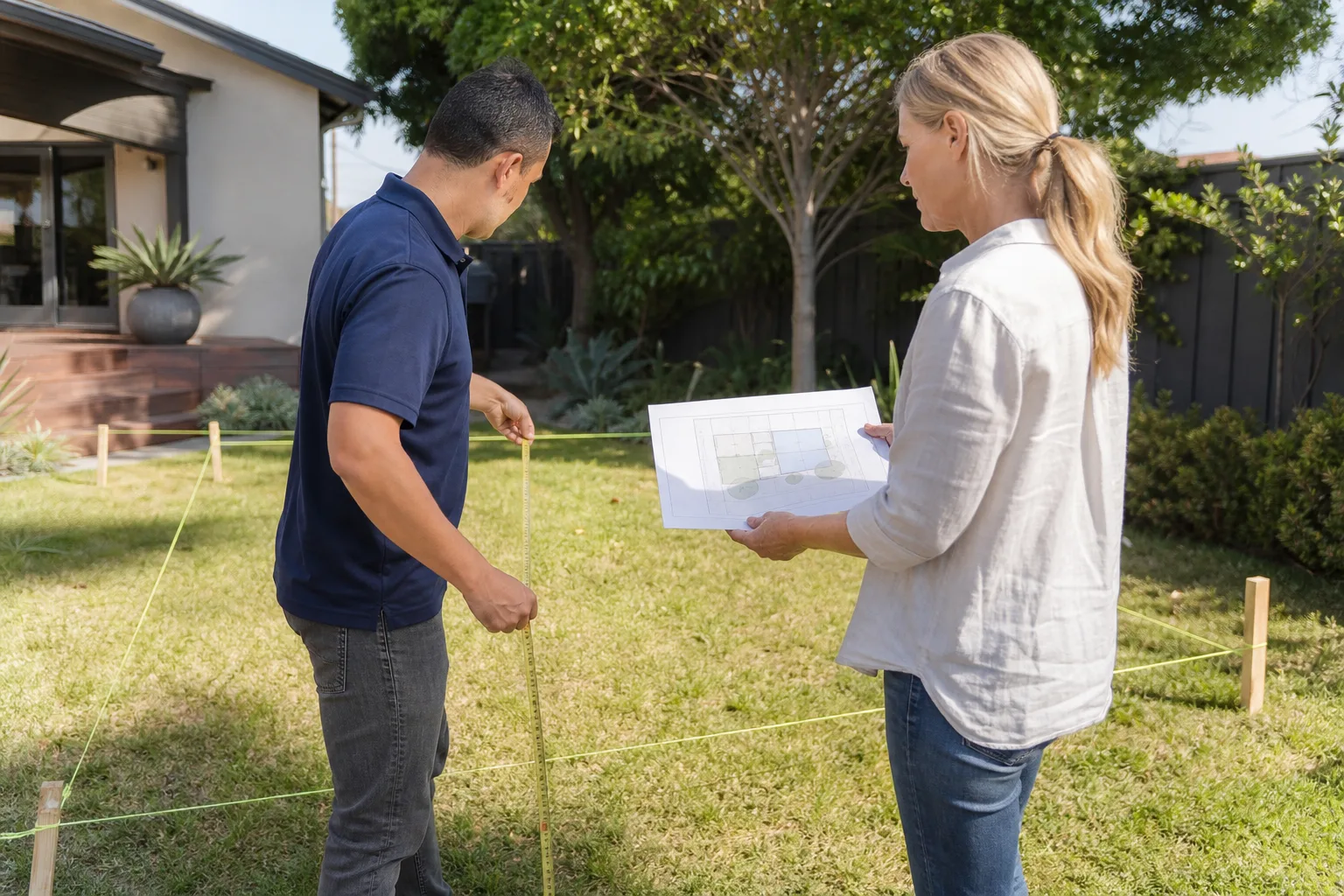
Lodgewick ADU San Diego offers free estimates in San Diego, call (619) 376-2760. We’ll walk your lot, check your zoning, and give you a written price before any work starts, including the permit fees, utility connections, and inspection schedule so there are no surprises at permit issuance.
Frequently Asked Questions
Plan check and permit fees for a typical detached ADU in San Diego run between $3,000 and $6,000, plus utility connection fees that vary by parcel. Impact fees are waived entirely for ADUs under 750 square feet. Call (619) 376-2760 for an exact quote on your specific lot.
State law requires sprinklers in an ADU only if the primary dwelling has them, but San Diego’s municipal code adds a requirement based on fire department response distance, which affects many outlying neighborhoods like Rancho Bernardo and Scripps Ranch. A sprinkler system adds $5,000 to $12,000 to the project.
With a clean first submittal, expect 6 to 8 weeks from application to permit issuance. Each round of plan check corrections adds 2 to 4 weeks. The state’s 60-day approval clock applies only after San Diego deems your submittal complete.
No. Unpermitted garage conversions are treated by the city as code violations, and they become a title defect that blocks sale or refinance. Legalizing an unpermitted conversion usually costs more than permitting it correctly from the start because concealed work must be exposed for inspection.
State law caps an ADU at 1,200 square feet or 50% of the primary dwelling’s square footage, whichever is larger, with an 800-square-foot minimum allowance regardless of the primary’s size. San Diego follows the state maximums without additional square footage restrictions.
It depends on your lot’s history and location. San Diego’s Development Services Department may require a geotechnical report for new foundations in areas with known expansive soils, including parts of La Mesa, El Cajon, and some canyon-adjacent neighborhoods. A soils report costs $2,000 to $4,000. Call (619) 376-2760 and we’ll check whether your parcel needs one before you spend the money.
The Bottom Line

California law makes it easier to build an ADU than at any point in state history, and San Diego generally honors the state’s pro-ADU framework. But the city’s local overlays on fire sprinklers, setbacks, coastal review, and completeness requirements mean that online guides that only cover state law will mislead you about what applies to your specific lot. The four inspections are non-negotiable, the fee picture depends heavily on square footage, and an open permit is a liability that follows the property. Get a written breakdown for your parcel before you commit to plans. That’s the only number that matters.
Written by Russ Delmar, Owner at Lodgewick ADU San Diego, serving San Diego since 2010.